Essex-based Digital Marketing Agency providing services like SEO, Content Marketing, Social Media Management, Web Design & Development, Video Editing, Branding, UI/UX & Email Marketing
WEB


Development
Marketing Services
Graphic Design
Packages
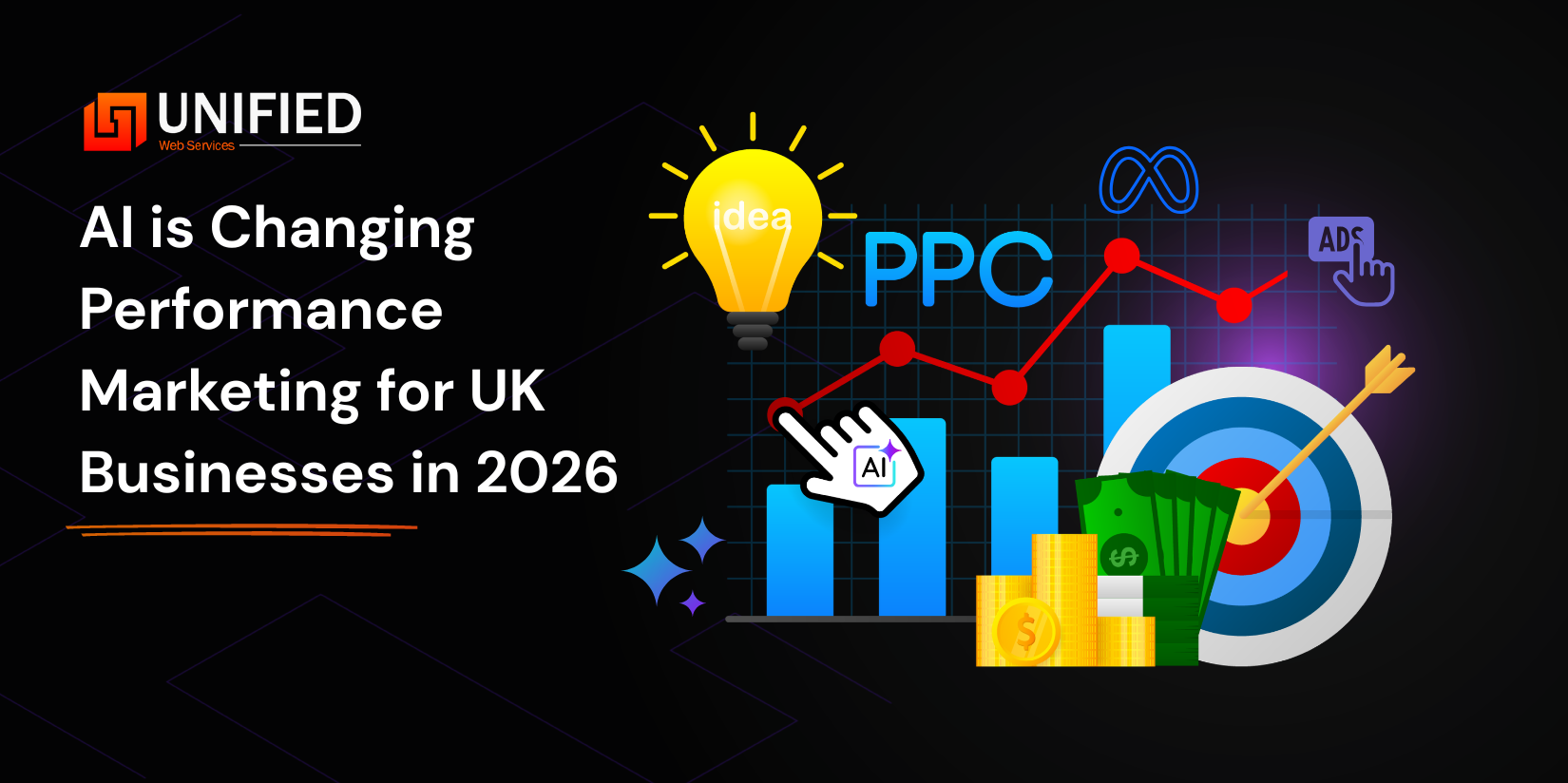
Every week UK businesses hand more control of their ad campaigns over to automated systems without fully understanding what those systems are actually doing. The budget goes in, the campaign runs itself, and the results can either look great or quietly underperform if nobody reviews what is happening.
AI performance marketing has moved from an experimental feature to a major part of how leading advertising platforms operate in 2026. Google's Performance max and Meta's Advantage+ campaigns can now handle areas such as bidding, audience optimization and creative testing, which means the skill of running ads well has changed alongside the technology behind it.
In this guide, we break down what has actually changed in AI-driven performance marketing, where it can deliver useful results for UK businesses and where it can quietly waste budget if it is not set up and monitored properly.
AI performance marketing refers to advertising campaigns where machine learning systems make many of the moment-to-moment decisions that previously required manual management. This includes choosing who sees an ad, how much to bid for an opportunity and, increasingly, which version of the ad creative to show.

Capabilities now handled by AI across major platforms:
Google's own guidance shows that advertisers can use Bidding automation to optimize campaigns towards specific conversion goals, although results still depend heavily on how accurately the campaign is configured and measured.
Related Blog: Google Ads vs Meta Ads for UK Businesses
One of the biggest shifts for advertisers has been the move away from manually adjusting individual bids. Instead of an account manager changing bids regularly based only on previous performance, many campaigns now use automated strategies such as Target ROAS, Target CPA and Maximize Conversions.
In practice, businesses that use a properly configured automated bidding strategy, with accurate conversion tracking feeding the system useful data, can allow the platform to make bidding decisions at a speed and scale that would be difficult to achieve manually.
This only works, however, when the platform has reliable information to learn from. A campaign that moves into automation without enough useful conversion data can struggle to perform consistently while the system learns.
There is no universal conversion number that guarantees automated bidding will stabilize. The amount of useful data required can vary depending on the campaign type, objective, conversion volume and account.
Agencies managing different accounts can therefore see very different learning patterns. A trades business and a local retailer may have completely different conversion volumes, budgets and customer journeys, so the time required for automation to become effective can vary considerably. This is one of the areas where the team at Unified Web Services spends a lot of time helping clients set the right foundations before switching fully to automated bidding.
AI's role now goes well beyond bidding. Both Google and Meta provide automated tools that can generate, combine and test different versions of ad copy, headlines and visual assets, allowing platforms to identify combinations that may perform better without requiring a marketer to manually create every variation.
Google also provides generative AI tools for performance max, giving advertisers additional ways to create campaign assets.
What this means in practice:
The trade-off is real. Businesses that never check what the system is actually producing can eventually discover an ad variation that performs well but does not fit their brand.
A UK financial services firm, for example, might find that urgency-driven language generates clicks but does not fit a brand built around trust, clarity and stability.
A national ecommerce brand and a local UK tradesperson or independent retailer can be affected by AI-driven campaigns very differently. Automated systems can work with large amounts of data, while smaller and highly localized campaigns may have fewer signals available for optimization.
Common mistakes that cause smaller campaigns to underperform:
None of these are necessarily failures of the technology itself. They are often setup and management mistakes that happen when a campaign is handed over to automation without giving the system the right information first.
Getting AI performance marketing to work well for a UK business, large or small, comes down to several things being configured correctly from the start.
Tips for getting it right:
Businesses running smaller monthly budgets need to be especially careful here. A national brand may have more room to absorb fluctuations while an automated system gathers useful signals. A smaller UK business running a modest budget can feel changes in lead volume much more quickly. This is exactly why many of the local and SME clients we work with at Unified Web Services prefer a more hands-on approach during the early learning phase.
AI performance marketing is not replacing strategy. It is changing what strategy actually involves. The businesses getting value from these systems need to understand what the platform requires, provide accurate data and continue reviewing how campaigns are being delivered.
The strongest approach is not simply to switch everything to automated bidding and walk away. Businesses still need to set appropriate objectives, maintain accurate tracking, review creative and understand whether the leads being generated are genuinely valuable.
As more UK businesses adopt these tools, the difference between a carefully configured account and one that is simply switched to automation can become significant. That difference can appear in areas such as lead quality, cost per lead and overall advertising efficiency.
The biggest change AI brings to performance marketing is not that campaigns can run with less manual input. It is that the way businesses manage advertising is becoming more focused on data, testing and informed decision-making. Bidding, targeting and creative optimization may increasingly happen through automation, but the direction behind those decisions still comes from the business.
For UK businesses, this makes 2026 an important point of transition. The businesses getting value from AI will not necessarily be those using the most tools, but those that understand where automation adds value and where human judgement still matters.
Performance marketing is moving towards a model where technology handles more of the process, while marketers concentrate on strategy, customer behaviour and commercial outcomes. Keeping that balance in place will be key to making AI a useful part of long-term marketing activity rather than simply another feature of the advertising platform.